Showing posts with label content based website. Show all posts

Friday, 24 April 2015

TedEd

Link to homepage and carbon cycle video link

Introduction
TedEd is a content based website with a large number of free videos covering a variety of topics. Although many of the science topics discussed are more of an extension of the content required in high school, there are a number of interesting videos which cover syllabus points. What's really cool about TedEd is the quizzes you can do after watching a video ("think") or the links to further information based on the video's content ("dig deeper"). This is great for student engagement as it allows the students to link what they're watching to potential questions in a test, and will hopefully motivate them to ask further questions and dig deeper.


Instructions
TedEd would be a great resource to use for revision or homework questions. Teachers could set a task where they ask students to watch the video and answer questions. This also offers an opportunity for differentiated instruction, as student looking for a deeper understanding can read the "dig deeper" page and gather more information. Below are screen shots of the three different activities related to the video.


Outcomes Covered
SC5-13ES explains how scientific knowledge about global patterns of geological activity and interactions involving global systems can be used to inform decisions related to contemporary issues
ES3 a. outline how global systems rely on interactions involving the biosphere, lihosphere, hydrosphere and atmosphere, including the carbon cycle (ACSSU189)


Science by Doing

Link to homepage

Introduction
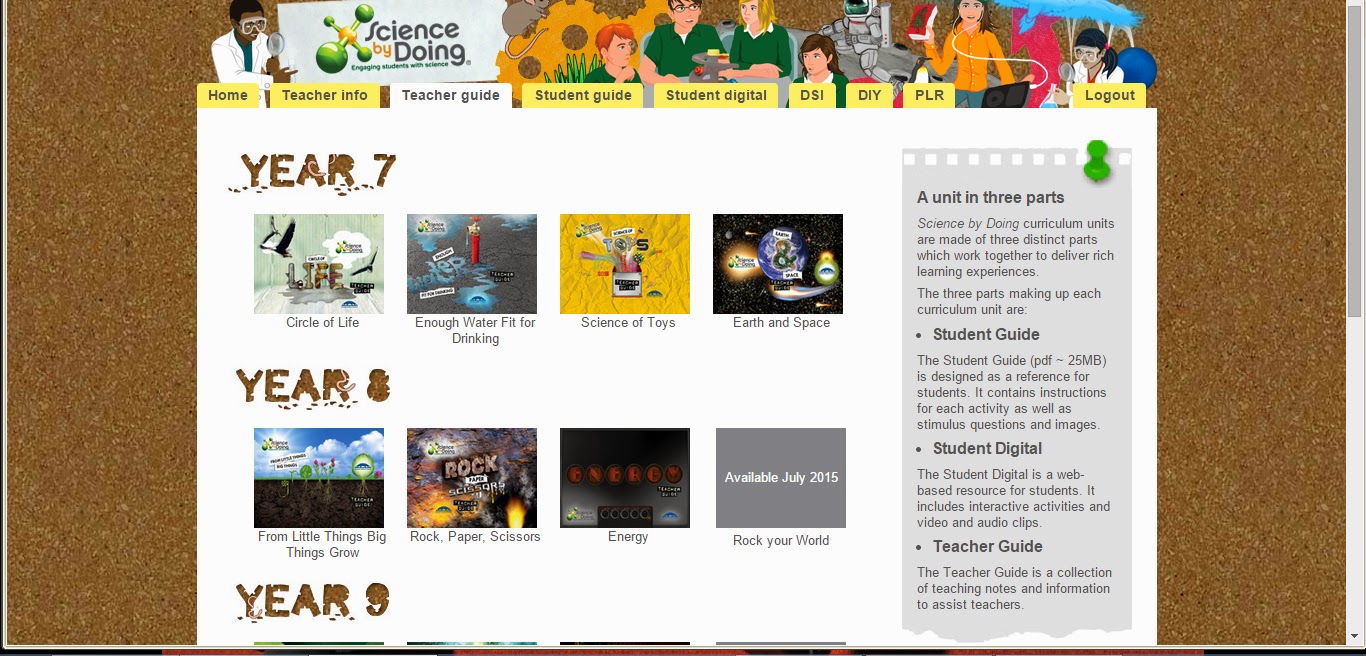
Science by doing is a content based website which has the science syllabus split up into contexts. These contexts are complete with detailed activities for teachers and students alike. Although this website requires creating an account and having this account approved, it is completely free for anyone, regardless of if they have a university or school email. This website is engaging as it teaches students content through a combination of videos, interactive animations and quizzes. This should hopefully keep students engaged by having a variety of activities to learn content, as opposed to just being taught through direct instruction in the classroom.

Instructions
When undertaking a unit, students could spend roughly 50% of a class going through the activities in their topic, and spend the remainder doing pracs or having class discussions about the content they've learnt. Here the example I use is the stage 5 (year 9) topic "Light, Sound Action".


First, the teacher should download the teacher packs for the topic which can be found by clicking the teacher tab on the homepage, then scrolling down to "Light, Sound, Action" under the year 9 topics heading. The teacher can then use the activities pack as a guide for class practicals and experiments throughout the unit.


Students access the content through the "student" tab at the top of the screen, and can then download the student guide. The student guide works as a kind of an interactive textbook they can work through in class to learn all the content they need to for a unit.

They can then click on the "student digital" tab at the top of the screen and work through the videos, activities and animations under each section.


Outcomes Covered
Stage 5

SC5-7WS processes, analyses and evaluates data from first-hand investigations and secondary sources to develop evidence-based arguments and conclusions

SC5-11PW explains how scientific understanding about energy conservation, transfers and transformations is applied in systems

SC5-10PW applies models, theories and laws to explain situations involving energy, force and motion
PW1 Energy transfer through different mediums can be explained using wave and particle models. (ACSSU182)
Students:
a. explain, in terms of the particle model, the processes underlying convection and conduction of heat energy
b. identify situations where waves transfer energy
c. describe qualitatively, using the wave model, the features of waves including wavelength, frequency and speed
d. explain, using the particle model, the transmission of sound in different mediums
e. relate the properties of different types of radiation in the electromagnetic spectrum to their uses in everyday life, including communications technology
f. describe the occurrence and some applications of absorption, reflection and refraction in everyday situations


Major Differences: Open and Closed Circulatory Systems

Link to page


Introduction

Major differences is a content-based website which compares various biological phenomena, Although the website has many comparisons which seem to extend beyond the HSC curriculum, the website is engaging as it compares concepts in simple terms that are easy to understand, therefore will help them with revision.


Instructions

Students should browse the site and create their own diagrams of the two circulatory systems. This way, students can see the information presented in both formats, and use their preferred format for revision.


Below is a screengrab of the website


Syllabus Dotpoints
Stage 6
8.3.4.2.5compare open and closed circulatory systems using one vertebrate and one invertebrate as examples

Scootle

Homepage link

Introduction
Scootle is a free website which allows the user to access a multitude of resources relating to the Australian curriculum, including the science curriculum. Filled with information, simulations and games based on the science curriculum, Scootle is a great tool to use for teachers when lesson planning as it allows for independent learning that is still structured.

Instructions
After creating a free scootle account, click on the "browse resources" tab and select "science".


Scroll down to year 10 science > biology and then the ACSSU185 (The theory of evolution by natural selection explains the diversity of living things and is supported by a range of scientific evidence.


Select the biology food web activity to learn more about an antarctic food web. Students should copy down the food web in detail into their exercise book to document their new knowledge.


Outcomes Covered
SC5-7WS processes, analyses and evaluates data from first-hand investigations and secondary sources to develop evidence-based arguments and conclusions
SC5-14LW analyses interactions between components and processes within biological systems
LW2 Conserving and maintaining the quality and sustainability of the environment requires scientific understanding of interactions within, the cycling of matter and the flow of energy through ecosystems.
c. describe how energy flows through ecosystems, including input and output through food webs (ACSSU176)
f. evaluate some examples in ecosystems, of strategies used to balance conserving,
protecting and maintaining the quality and sustainability of the environment with human activities and needs

Wednesday, 15 April 2015

Khan Academy

Homepage

Introduction

Khan Academy is a free website with educational videos covering a range of topics including history, economics, maths and science. The science section of Khan Academy is vast and covers many topics in physics, chemistry and biology. A major advantage of the website is that it allows students to work through content at their own pace. When they're in class they have to keep up with the pace that the teacher sets, but in Khan Academy they can pause videos and go back to any sections they didn't understand and view them again.

In addition to educational videos, there's an entire section below each video which gives users an opportunity to ask questions and quiz each other. There's also a section called "tips and thanks" under each video where many users have linked to educational games and sites that may be useful for furthering students' knowledge.

These videos could be used in conjunction with or instead of direct classroom instruction. By using this "flipped classroom" approach, there is more time for students to undertake practical work and they can work through the content at their own pace for homework, perhaps giving them a greater understanding of the content then they would have otherwise. If used in conjunction with traditional classroom teaching, Khan Academy provides a way for students to revisit and revise information they may have forgotten, didn't understand in class or just want to have a fresh perspective on.


Instructions

To begin using Khan Academy, click the link at the top of the post. This will take you to the Khan Academy homepage. The site recommends that you sign up in order to get extra features such as progress monitoring and interactive revision exercises, but this is not needed to unlock the basic content of the site.


To view the lessons, click the "Subjects" tab at the top of the screen and select your subject. I clicked science > biology


There are four biology topics that are covered. I clicked on "cellular and molecular biology".


From here, all the content in cellular and molecular biology is displayed. I chose to look at an overview of organelles.


As you can see here, there is the main video section of the page and also the questions and comments section below. The videos are hosted through youtube and therefore can be embedded in the online learning system of a teacher's choice, if they choose to do so.


Example in class
An example of how to use Khan academy would be as the flipped classroom. Take for example a lesson on states of matter. Instead of covering this material in class, the students could watch one or two videos at home and learn the theory, then perform an experiment during class that further expanded their knowledge or allowed them to see the theory in action.


Outcomes Covered
Stage 4
SC4-16CW: a student describes the observed properties and behaviour of matter, using scientific models and theories about the motion and arrangement of particles
CW1 The properties of the different states of matter can be explained in terms of the motion
and arrangement of particles. (ACSSU151)
a. describe the behaviour of matter in terms of particles that are continuously moving and interacting
b. relate an increase or decrease in the amount of heat energy possessed by particles to changes in particle movement
c. use a simple particle model to predict the effect of adding or removing heat on different states of matter
d. relate changes in the physical properties of matter to heat energy and particle movement that occur during observations of evaporation, condensation, boiling, melting and freezing
e. explain density in terms of a simple particle model
f. identify the benefits and limitations of using models to explain the properties of solids, liquids and gases